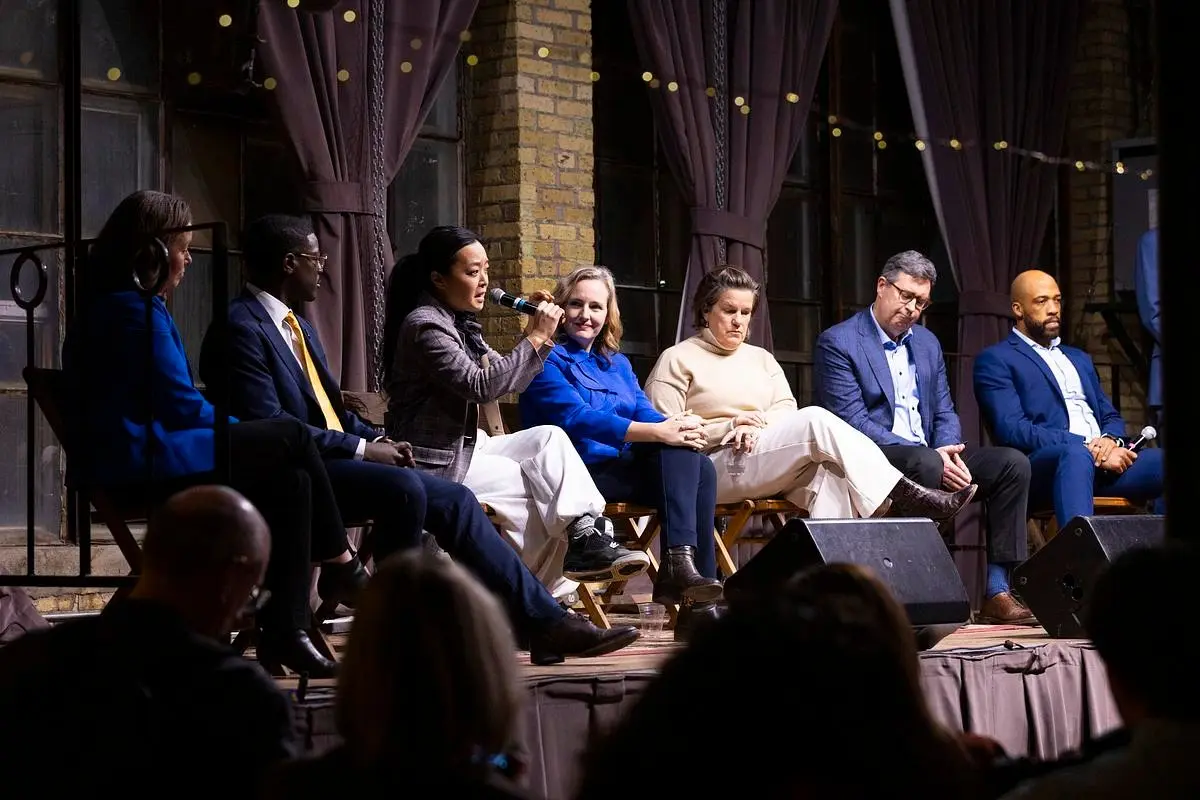


The state’s most devoted Democrats are scheduled to gather in Madison this weekend for the party’s annual convention where the seven-way race for the Democratic nomination for governor is likely to take center stage.
Democratic caucus and county party leaders told Wisconsin Watch they are hopeful the convention could be a clarifying moment in the primary campaign on who has enough support to make it to the August primary. None of the main contenders dropped out ahead of last week’s filing deadline, so seven names will appear on the Aug. 11 Democratic primary ballot.
When Democrats convene at the Monona Terrace Convention Center on Saturday, there will be less than 45 days until early voting starts in late July.
“If their message does not ring true to the delegates at the convention, they better listen to the applause because people will be honest with them,” said Susan Chandler, the 1st Congressional District chair and vice chair of the Walworth County Democrats. “Everybody who goes to the convention is a highly engaged Democrat, and for every one of those highly engaged, we all know 10 people who are not. We’re bringing a lot of background to that convention and critically listening to these candidates.”
After Democratic Gov. Tony Evers decided not to run for a third term, seven Democratic candidates submitted the signatures to make the ballot. They include former Lt. Gov. Mandela Barnes, former Department of Administration Secretary Joel Brennan, Milwaukee County Executive David Crowley, Madison state Rep. Francesca Hong, former Wisconsin Economic Development Corp. Secretary Missy Hughes, Lt. Gov. Sara Rodriguez and Madison Sen. Kelda Roys.
Meanwhile, Wisconsin Republicans have coalesced around U.S. Rep. Tom Tiffany, who received the Republican Party of Wisconsin’s endorsement at their annual convention in May and was endorsed by President Donald Trump in January. Tiffany has just one primary opponent, Andy Manske, a 27-year-old medical service technician.
“We want to know who is best situated to make bold sweeping change here in Wisconsin to provide a better life for Wisconsinites, and who is best situated to beat Tom Tiffany in a head-to-head,” said Brett Timmerman, the chair of the Milwaukee County Democratic Party. “I think that people are going to the convention looking for somebody to stand out in a meaningful way to deliver that message of why they think they are the best person to carry the torch forward.”
The closest comparison to this year’s field is the 2018 Democratic gubernatorial primary when 10 candidates ran for the opportunity to unseat then-Republican Gov. Scott Walker. Two dropped out in June before the primary that year.
Evers, who had statewide election experience as the superintendent of public instruction, won the Democratic primary that year with 42% of the vote and later defeated Walker in the general election. Evers didn’t win a majority of primary voters, but his closest opponent only mustered 16.4% of the vote.
A large primary, like the one in 2018, forces candidates to explain why voters should support their campaign, said Martha Laning, who served as the chair of the Democratic Party of Wisconsin during the 2018 election cycle.
At the 2018 state Democratic convention, the candidates all had the opportunity to make a three-minute pitch to party die-hards on what they would do for Wisconsin, Laning said. A spokesperson for the state party said all seven of the Democrats who made the ballot will also have a chance to speak this weekend.
“I think it’s great to put all of the candidates up there and to just let people know what their options are,” Laning said. “Again, any of them will be better than Tom Tiffany, so the more people talking about how they would do things and how they would improve people’s lives in Wisconsin is a good thing for us.”
Negativity and consolidation
It’s been a quiet primary among the slew of Democratic candidates over the last six months, with few events that set the campaigns apart. Hong led the field with 14% in the most recent Marquette University Law School Poll in March. The poll also found that 65% of voters were undecided on who to vote for in the primary.
It’s worth watching if the convention is a place where candidates take negative swipes at each other with the August primary on the horizon, said Anthony Chergosky, an associate professor of political science at the University of Wisconsin-La Crosse.
“This has been a remarkably chill campaign, and I’m wondering if we’re going to see things heat up a little bit,” Chergosky said.
Hints of discord are emerging in the primary. Hughes last month was the only candidate to publicly support the failed $1.8 billion bipartisan surplus deal negotiated between Evers and Republican legislative leaders. After the deal failed in the Senate, Hughes posted unnamed criticism of “certain self-serving Democratic candidates for governor who would rather boost their own personal political ambitions than serve our kids and taxpayers.”
The Milwaukee Journal Sentinel last week reported that Hong was sued in May by Capital One for nearly $30,000 in credit card debt, which her campaign said had already been paid. Hong in a video posted on social media said the story showed her “opponents are scrambling.”
“They are scared of what we’ve built, our platform that’s resonating with working class people all across the state who feel left behind, our organizing infrastructure that’s being built stronger every day,” Hong said. “They want to pull me off track and how dare they.”
The convention could also serve as a milestone for consolidation in the race in the coming weeks, Chergosky said. A fractured field means one of the candidates could win with just 30% of the vote, but the math changes if someone drops out, he noted.
For Gloria Hochstein, the chair of the party’s Rural Caucus, the circumstances of a large field of candidates make her wish ranked-choice voting was an option for this primary.
“The problem is that there are some really good people running, and the thoughtful voter is really going to have to decide where his or her vote should be,” Hochstein said.
But the convention could “turn the tide” for some candidates who might drop out if they see they don’t have the statewide reach among the party’s most faithful, she said.
“I think that’s the realization, some of the candidates, I hope they come to sooner rather than later,” Hochstein said.